
Tamron SP 500mm f/8 Lens - An Accidental Favorite?
How I came to own this lens
First things first, this blog post is not a full review of this lens. It’s merely an accounting of my experience with this lens so far. If you’re looking for more of a full review of this lens, including all the technical specs, check out this article here after you’re done reading.
The Tamron SP 500mm f/8 Tele Macro BBAR MC 55BB (whew, what a mouthful!) Is a “vintage” lens made by Tamron in various iterations starting from around 1979. It’s a reflector type lens, consisting of mirrors in addition to traditional lens elements to make a lens far smaller than traditional lenses of a similar focal lengths. That being said, why is this lens an “accidental” favorite of mine? Let’s get into that!

The Tamron SP 500mm f/8 attached to my Canon R7.

Adapters exist to mount this lens to most modern cameras.
Back in July, I was researching lenses that I could use for a variety of deep sky astrophotography targets, and I settled on the Tamron SP 200-500mm F5.6 BBAR MC 31A. KEH.com had a used one for sale in good condition, so I placed the order. I also ordered and adapter from K&F Concept that would allow me to mount the lens on my Canon RP and R7 bodies. However, when I received the package a couple days later, I knew something wasn’t right before I opened the box. It was too small and light to contain the correct lens. Sure enough, that was confirmed upon opening.

The Tamron SP 200-500 f/6.3 that I had ordered.
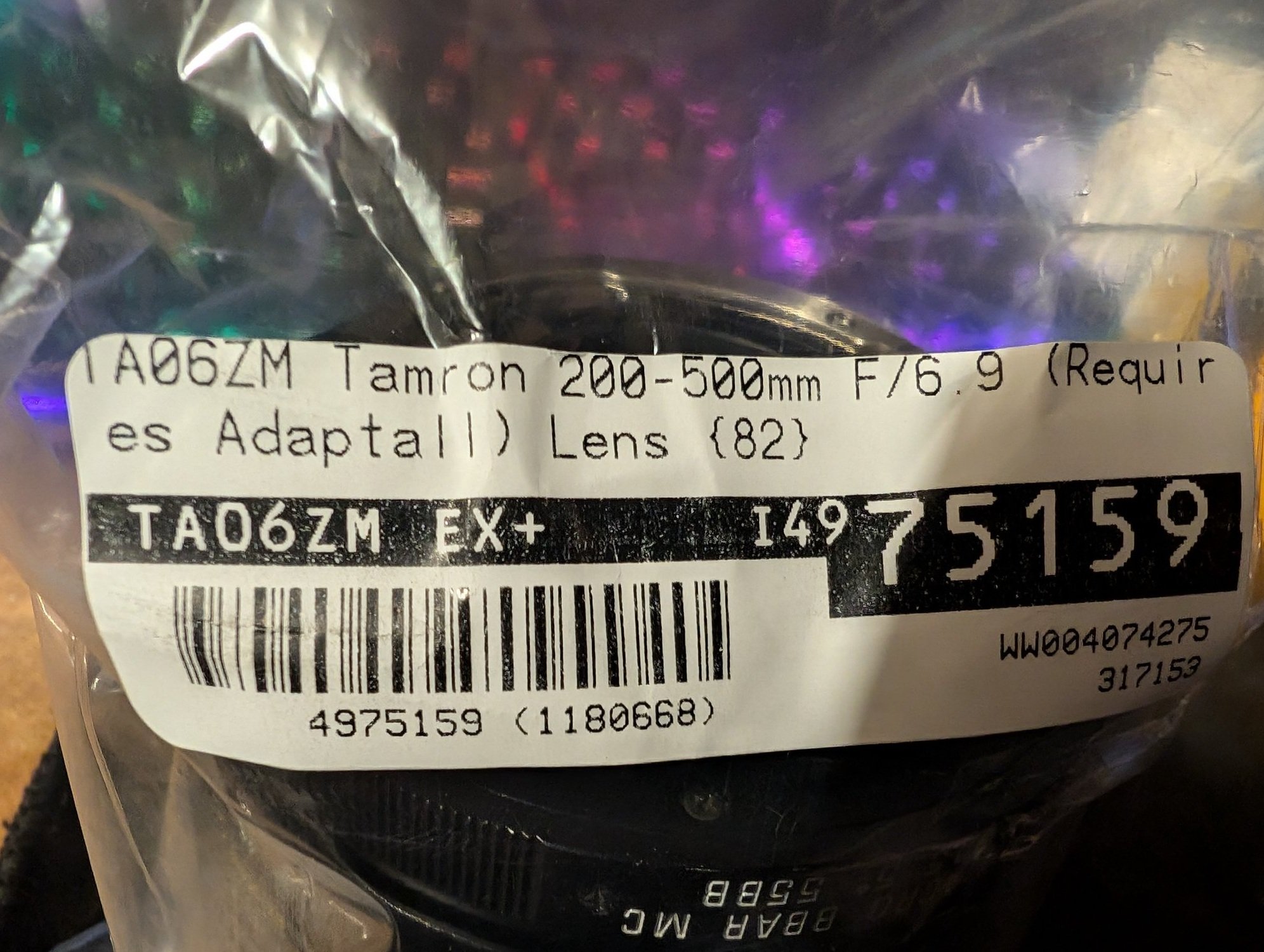
The lens arrived with the correct label on the incorrect lens.
The lens I received was the 500mm mislabeled as the 200-500mm. I contacted KEH and to their credit, they quickly apologized for the error and promptly emailed me a return shipping label. The offered me a full refund, as they didn’t have another copy of my desired lens in stock.
This happened on a Friday afternoon, and I wouldn’t have the opportunity until Monday to return the lens. I had already received the adapter, and had a weekend with the lens, so I decided to slap it on the Canon R7 and take it for a spin. I am so very glad I did! Take a look at a couple of the test shots I did that weekend.

A butterfly comes in for a landing. 1/800th sec, ISO 1000, Canon R7

The crescent moon, uncropped. 1/100th sec, ISO 4000, Canon R7
After a couple days of shooting with this lens, I decided not to return it. The accidental mislabeling of this lens opened up some fascinating capabilities, along with a few challenges. We’ll start first with the challenges that come with a lens like this.
Challenges with this lens

K&F Concept Tamron to RF Adapter
The first and most obvious challenge when using a vintage lens like this on a modern mirrorless or DSLR camera is incompatibility of the lens mount. This lens uses Tamron’s Adaptall 2 lens mount, which requires an adapter to fit it to your camera of choice. This in itself isn’t a huge challenge. Several companies make adapters to fit nearly any lens to virtually any camera body. In this case, I purchased an Adaptall 2 to Canon RF mount adapter from K&F Concept. I couldn’t find this particular adapter at any US based retailer, so I had to order direct from the company, and the adapter shipped from China and took several days to arrive. It was packaged well, and works perfectly.
The second challenge with this lens (especially for those used to modern digital cameras and lenses) is that it contains no electronics and is fully manual. There is no autofocus or image stabilization. This lack of on board image stabilization makes getting photos without motion blur very difficult at best and almost impossible at worst. There are ways around this though. On a camera such as my Canon RP, which has no IBIS (In Body Image Stabilization), very fast shutter speed and high ISO could make useable handheld photos, albeit this may introduce a lot of noise to the photo depending on the lighting conditions. Better yet would be the use of a monopod, or a tripod in conjunction with an external shutter release to get the best results with this lens on a camera without IBIS.
Many of the more modern mirrorless cameras that are coming to market, like my Canon R7, have IBIS. The R7 for example has up to 5 stops worth of stabilization and is adjustable to match the focal length you are using. This helps to eliminate much of the movement and vibrations introduced when shooting handheld, and makes vintage manual lenses a much more viable option check out the following two examples, shot on the R7 with IBIS off and on. Both were shot at a relatively slow shutter speed for focal length. of the lens.

Canon R7 without IBIS, 1/200th sec, ISO 320

Canon R7 with IBIS, 1/200th sec, ISO 320

Focus peaking simulated, credit: PetaPixel
The final challenge with this lens is focusing. Focus can be a challenge due to a very shallow depth of field, particularly with closer subject. This can be partially overcome with modern cameras that have focus peaking. This functionality analyzes the scene and superimposes a highlighting effect over high contrast areas that are in focus. Even with this, it can be difficult to get the focus nailed down just right. Minute turns of the focus ring on the lens have significant changes to the area in focus. It can help to get the focus close on nearer targets and physically move the camera back and forth slightly to fine tune the focus area. The following example image (image credit: PetaPixel) shows a simulation of what focus peaking looks like with the Canon R7.The resulting images can be slightly soft and a bit flat in contrast, a characteristic of many mirror lenses. In my experience, this can usually be corrected with slight adjustment during post-processing for most images.
Why this lens has become one of my favorites
You’re not here for all the negatives though, are you? You’re here to find out why this lens has quickly become one of my favorite lenses that I own.
Compact size is the first reason. For a 500mm lens, it is very short and light. The lens itself, without the adapter and lens hood, is only about 3.6 inches long and 3.3 inches in diameter, and weighs a little under 1.2 pounds . With the adapter and aftermarket hood, the length is about 6.25 inches. Compare this to a modern non-mirrored 500mm lens, like the TTArtisan 500mm f/6.3 Lens, which is nearly 12.5 inches long and weighs just over 3.5 lbs. This small package makes it much easier to move around, and won’t wear you out nearly as quickly is using this lens on the move.
Next is the focal length. 500mm is a lot of zoom. This makes this lens excellent in certain circumstances for things like wildlife and bird photography, and for solar and lunar photography among others. When mounted to a camera with an APS-C size sensor like the R7, you get a crop factor of 1.6, you get a 35mm equivalent of 800mm. Combined with a 1.4x teleconverter, you get full 700mm full frame and a whopping 1,120mm equivalent on APS-C. That is some insane level of zoom, and opens up some unique photo opportunities. The following examples were taken with the lens on the R7, some without the 1.4x teleconverter and some with it. In addition, an 82mm 20 stop ND filter allows for direct imaging of the sun, as in one of the examples below. All were taken handheld, with the exception of the full moon rising shot, which was stabilized on a hay bale.

Butterfly on Passionflower, Canon R7, 800mm/eq, 1/800th sec, ISO 250, f/8

Full Moon Rising, Canon R7, 1,120mm/eq, 1/1000th sec, ISO 1600, f/11

Bee in Flight and Passionflower, Canon R7, 1,120mm/eq, 1/5000th, ISO 6400, f/11

The Sun, Canon R7, 1,120mm/eq, 1/1000th sec, ISO 320, f/11, 20 stop ND filter
The third thing I love about this lens is that it has a very short minimum focusing distance. It can focus as close as 6 feet. Compare this again to the TTArtisan 500mm f/6.3 Lens, which has a minimum focusing distance of around 10 feet. This shorter minimum focus distance, combined with it’s compact length, means you can get much closer to your subject than with other comparable focal length lenses. This allows you to get some incredibly close-up shots of very small subjects, especially when using the 1.4x teleconverter as well.

Bee on Sunflower, Canon R7, 800mm/eq, 1/500th sec, ISO 1250, f/8

Butterfly on Flower, Canon R7, 1,120mm/eq, 1/1000th sec, ISO 3200, f/11
Another thing I love about this lens is the quirky way this lens renders highlights in the bokeh. Bokeh is the out of focus area in photos. Due to the nature of this being a mirror lens, there is a small round mirror at the front end of the lens. This blocks light in that area, and this produces a “donut” bokeh effect. This can be both a benefit or a distraction. It can add a unique pop to an image if used properly, or can make a background very busy and distracting.

Morning Dew on Grass, Canon R7, 800mm/eq, 1/1000th sec, ISO 200, f/8

Red Flower, Canon R7, 800mm/eq, 1/1000th sec, ISO 3200, f/8
The final thing that makes it a favorite lens of mine is the price. It comes in at around $100, depending on the condition and seller. Compare this to other lenses with similar features. The TTArtisan 500mm f/6.3 Lens retails for about $329. The Canon RF 600mm f/11 IS STM Lens retails for about $800. This lens gives a great bang for the buck!
The Tamron SP 500mm f/8 Tele Macro BBAR MC 55BB is a great lens, and has quickly become one of my favorite lenses to use to get some unique and beautiful photo. If you decide to grab one of these for yourself, I hope you can push through some of the lens’ challenges and use it to make some great, unique images of your own!



I may earn a commission if you purchase an item using one of my links.